The Other Rome
A journey through the fascinating geometries
of the EUR neighborhood
By Claudio Lozzi
ome may be defined by its past, but one of its most intriguing corners offers a bold, futuristic vision. Built in the 1940s, the EUR neighborhood in the south of the city feels like a dream conceived in stone. With its clean lines, monumental scale, and haunting stillness, it’s a place where rationality and surrealism coexist in harmony. EUR resembles a painting by Giorgio de Chirico—metaphysical, geometric, and eerily frozen.
The district was built as part of Benito Mussolini’s ambition to host the 1942 World’s Fair (Esposizione Universale di Roma). His aim was to glorify Fascism through classical grandeur fused with modernist ideals. The war interrupted that dream, but the vision remained and evolved over the decades into a living museum of 20th-century architecture, also becoming a compelling destination for travelers who crave something beyond the typical Roman postcard.
A different Rome begins here
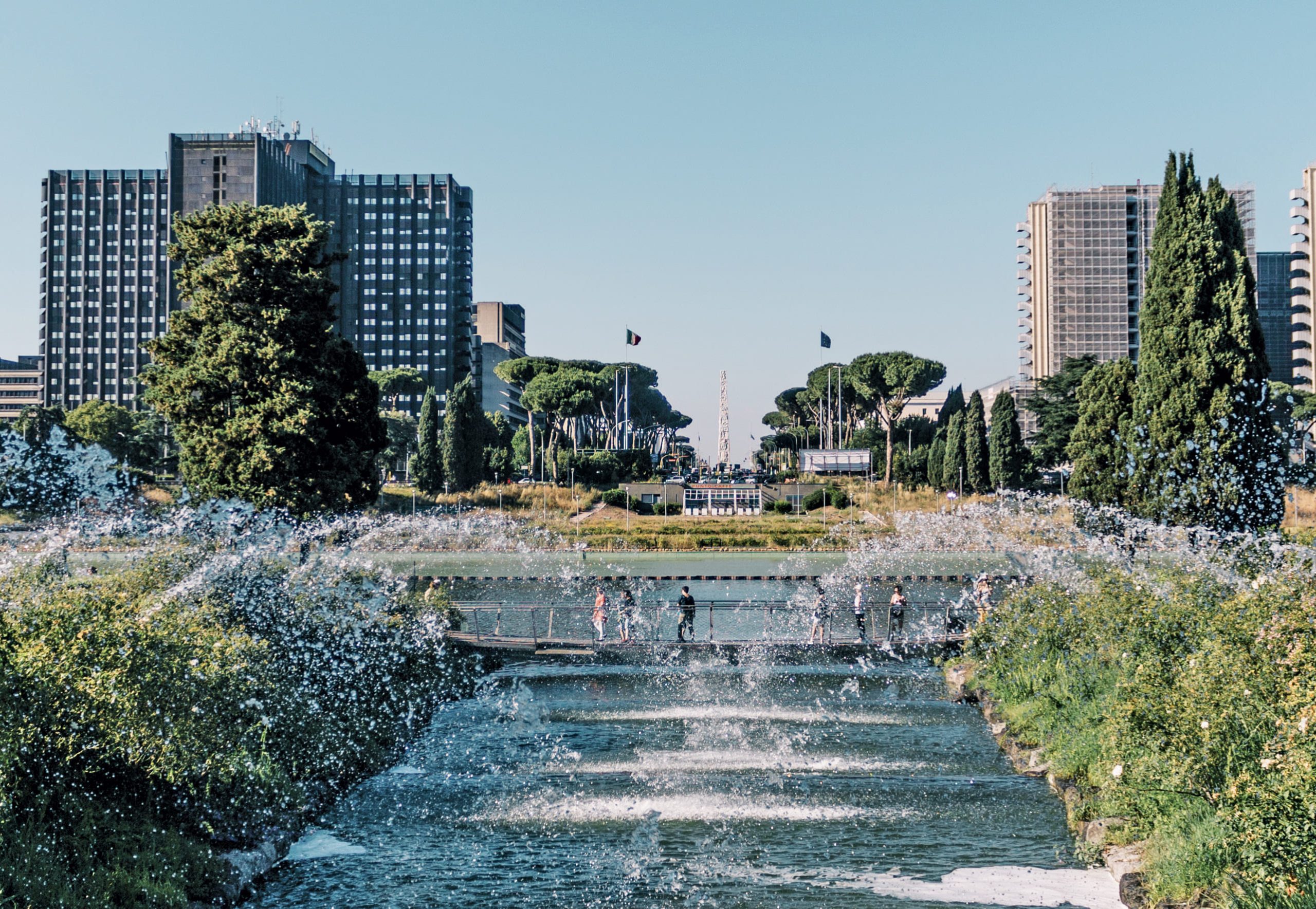
Walking through EUR is like stepping into another dimension of the Eternal City: vast plazas, soaring colonnades, and monumental buildings that feel both retro-futuristic and ancient at once. The neighborhood was designed to impress. Grand boulevards lead the eye toward distant horizons, and wide-open spaces create a meditative hush, amplifying the district’s surreal atmosphere. The layout, with its precise geometry and solemn rhythm, was meant to evoke the order and power of ancient Rome—but filtered through the sharp logic of 20th-century urbanism.
Piazza Guglielmo Marconi, with its central obelisk and surrounding rationalist architecture, is a perfect starting point. Nearby, the stark and statuesque Palazzo della Civiltà Italiana, often called the “Square Colosseum,” looms like a minimalist echo of its ancient ancestor. Designed by architects Giovanni Guerrini, Ernesto La Padula, and Mario Romano, its six levels of arches and symmetrically placed statues give it an almost digital quality—as if it were 3D-printed straight from a metaphysical dream.
Timeless silence, lasting impact
What makes EUR truly unforgettable is its atmosphere. The large boulevards, the buildings, and the parks provide a stillness that invites introspection. Both a symbol of totalitarian ambition and a celebration of artistic vision, this neighborhood offers the rare opportunity to witness the lesser-seen face of Rome. Come for the architecture, stay for the silence, and leave with a deeper understanding of how even Rome’s most futuristic district is ultimately a meditation on time.

CULTURAL FINDS IN EUR
Palazzo della Civiltà del Lavoro
Nicknamed the “Square Colosseum” by locals, this iconic landmark echoes the form of its ancient predecessor. Designed by Giovanni Guerrini, Ernesto Bruno La Padula, and Mario Romano, it was conceived as the centerpiece of the Esposizione Universale Roma and inau- gurated in November 1940. The building is set to become the headquarters of the luxury fashion house Fendi. Viale della Civiltà del Lavoro, 50.
Palazzo dei Congressi
Designed by Adalberto Libera and completed in 1938, this imposing reinforced-concrete structure was described by its architect as “a basili- ca, vast like a temple.” Its monumental scale and clean lines make it a stand- out example of Rationalist architecture. Piazza John Fitzgerald Kennedy, 1.
Church of Saints Peter and Paul
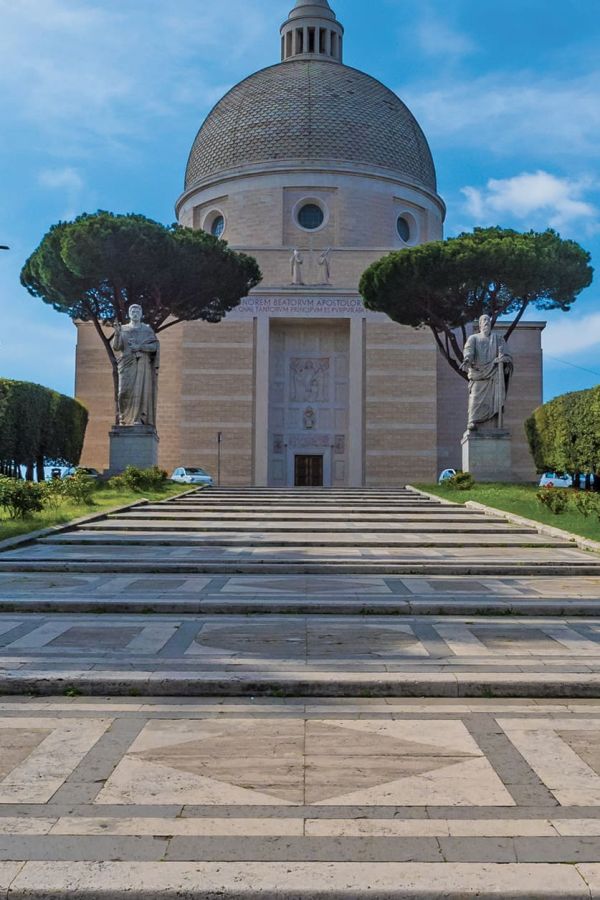
Clad in Roman travertine, this striking church was originally intended to serve as Mussolini’s mausoleum. Today, it dominates the neighborhood skyline, crowned by statues of Saints Peter and Paul gazing over the city. Its Greek-cross plan draws inspiration from Michelangelo’s original design for St. Peter’s Basilica. Piazzale dei Santi Pietro e Paolo, 8.
Muciv – Museo delle Civiltà
The Museum of Civilizations include two locations: the Palace of Sciences, dedicated to prehistory and proto- history, houses an impressive collection of artifacts from all ages, as well as contemporary arts and cultures collection; The Palace of Folk Arts and Traditions features Italian folk arts and popular traditions and customs. Piazza Guglielmo Marconi, 8. Piazza Guglielmo Marconi, 14. Tel. 06549521. museodellecivilta.it
Planetarium and Astronomical Museum
Proof that science can be fun, this interactive museum explores the Earth, the solar system, and distant gal- axies. Engaging and accessible, it’s one of the rare attractions that fascinates both children and adults alike. Piazza Giovanni Agnelli, 10. Tel. 0682077304. planetarioroma.it
Palazzo dello Sport
Conceived by Marcello Piacentini and Pier Luigi Nervi, and built for Rome’s 1960 Olympic Games, this vast arena can accommodate more than 16,000 spectators. Today, it hosts major international concerts and top musical acts, making it one of the city’s premier entertainment venues. Piazzale Pier Luigi Nervi, 1.
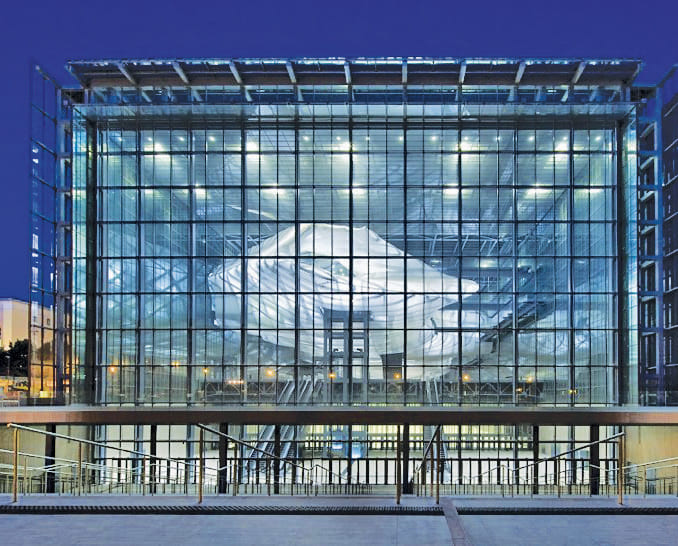
La Nuvola – Rome Convention Center (pictured above)
Known as “The Cloud,” this futuristic convention center designed by Massimiliano Fuksas and opened in 2016 features a translucent, floating structure suspended inside a glass shell. It stands as a bold symbol of Rome’s contemporary architectural vision and global outlook. Viale Asia, 40/44.
ENI Skyscraper
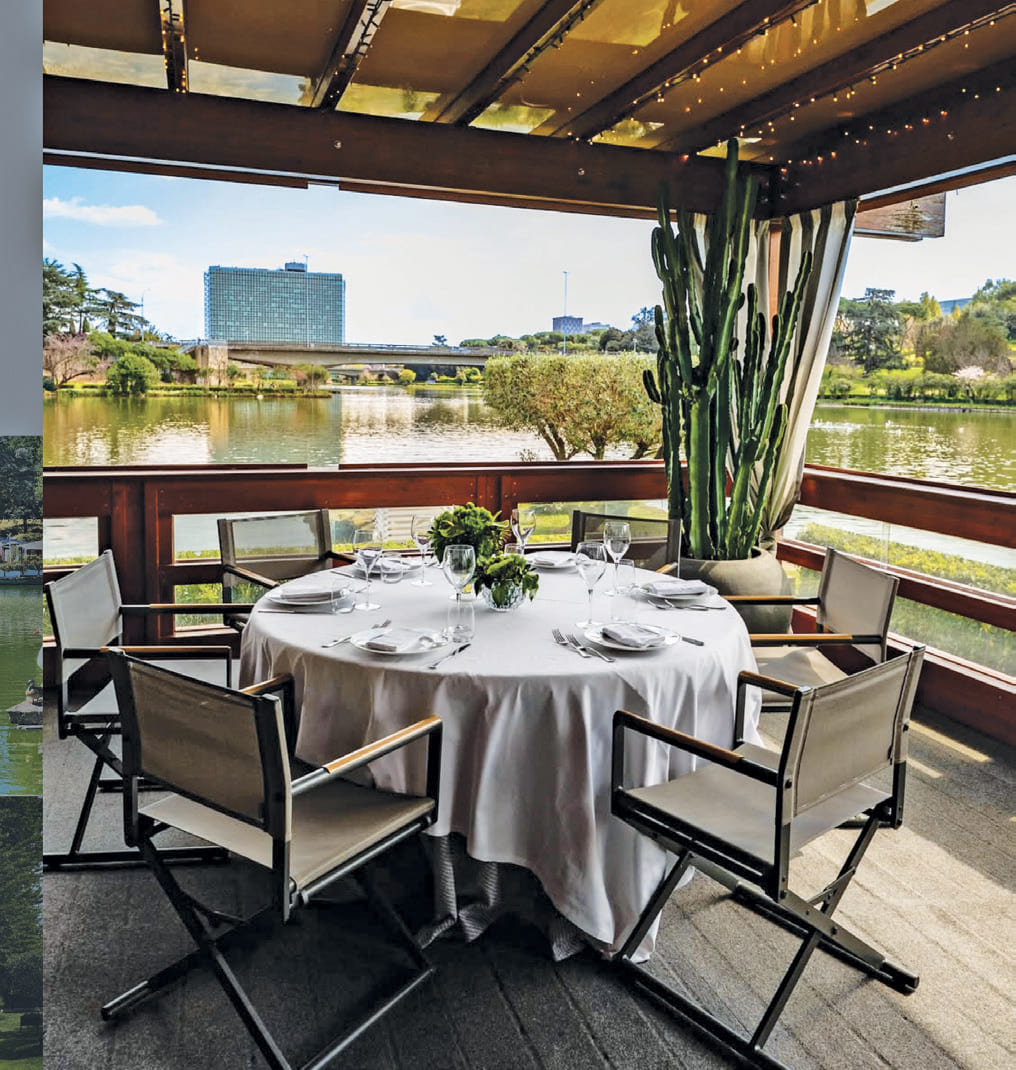
The third-tallest building in Rome, this 21-story skyscraper overlooks the neighborhood lake—a peaceful green oasis ideal for picnics beneath cherry blossom trees. The surrounding park is perfect for a stroll, a break in the shade, or even a canoe ride. Piazzale Enrico Mattei, 1.