
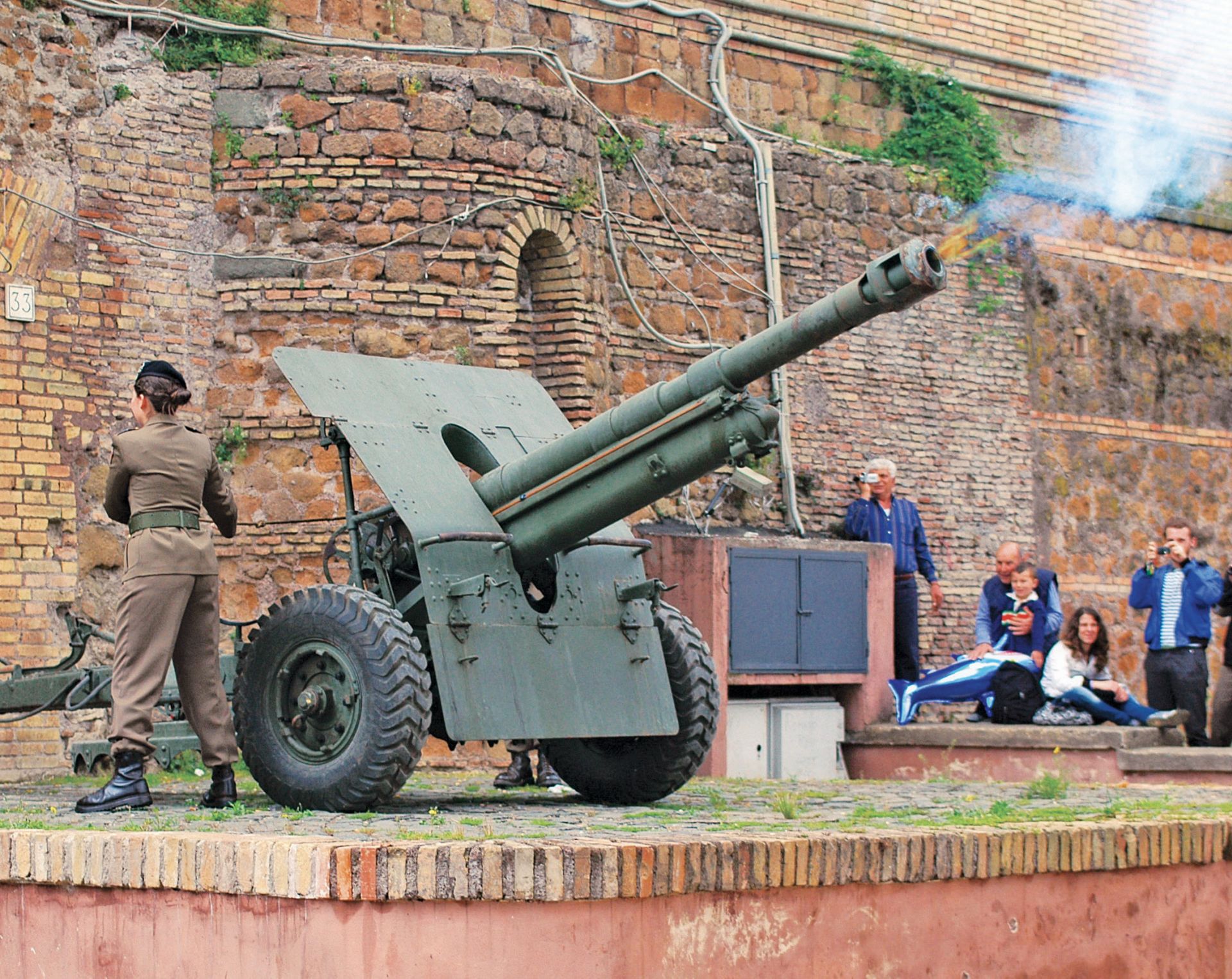
Rome’s daily big bang
Every day at noon, a historic cannon fires from Janiculum Hill. But why? – By Claudio Lozzi
For more than a century, the serenity of Rome’s Janiculum Hill has been punctuated each day by a single thunderous roar. Precisely at noon, the blast of a cannon echoes across the city, announcing to Romans and visitors alike that half the day has passed. This striking tradition dates back to 1847, when Pope Pius IX introduced the daily cannon shot to standardize time throughout Rome. Until then, the exact hour was often determined by the metallic peal of church bells—signals that could vary depending on distance and acoustics. To eliminate confusion, a cannon was fired at noon, providing an unmistakable citywide time marker. In those early days, the moment of firing was signaled by dropping a large black wicker ball from the summit of St. Ignatius Church. Although the cannon itself has changed over the years, the ritual has endured. Early versions included a 75mm field cannon, later replaced by a howitzer captured during the 1915–1918 war. Since 1991, the daily duty has been carried out by a WWII-era howitzer. The cannon’s home has also shifted over time. First placed at Castel Sant’Angelo in 1847, the cannon was later moved to the flat summit of Monte Mario. Finally, in 1904, it was relocated to Janiculum Hill, where it fires a daily blank charge made from one kilogram of gunpowder. The City of Rome underwrites the cost of maintaining this living timepiece, while a specialized unit of the Italian Artillery Division is responsible for igniting the ceremonial fuse.