The Roman temple of power and sport
From ancient Roman spectacle to Fascist ambition, Rome’s iconic Foro Italico shows how sports can serve politics and identity.
By Claudio Lozzi
Sporting events have long been central to Rome’s identity, with colossal spectacles such as the games at the Circus Maximus and the gladiatorial contests in the Colosseum serving not only as entertainment, but also as instruments of power. For the Roman Empire, public shows were a means of both appeasing the masses and asserting imperial dominance, and this tradition was woven deeply into the fabric of Rome’s civic life.
In the 20th century, this legacy of Roman glory found new expression under the rule of Benito Mussolini. Seeking to restore Italy to what he perceived as its rightful place in the world, Mussolini envisioned a return to the power and magnificence of ancient Rome, particularly in the realm of sport. This vision took physical shape with the construction of the Foro Italico, originally named Foro Mussolini, between 1928 and 1938. Designed by architects Enrico Del Debbio and Luigi Moretti, the complex was inspired by the monumental forums of ancient Rome, blending Fascist ideology with the sporting culture of the past.
Mussolini’s ultimate goal in creating the Foro Italico was to position Rome as the host of the 1940 Summer Olympics. Although the bid was unsuccessful — the games were assigned to Japan but then canceled due to World War II — the Foro Italico would eventually host the 1960 Olympics, fulfilling its original purpose. Today, the complex stands as a modern sports hub, housing several venues such as the Aquatics Center, a prestigious Tennis Club, and the Olympic Stadium, the largest sports arena in Rome.
Yet, beyond its function as a sports complex, the Foro Italico is also an enduring symbol of Mussolini’s attempt to infuse Fascist Italy with the aura of ancient Rome. The site is dotted with politically charged artworks — frescoes and mosaics that reflect the regime’s vision of power and national pride.
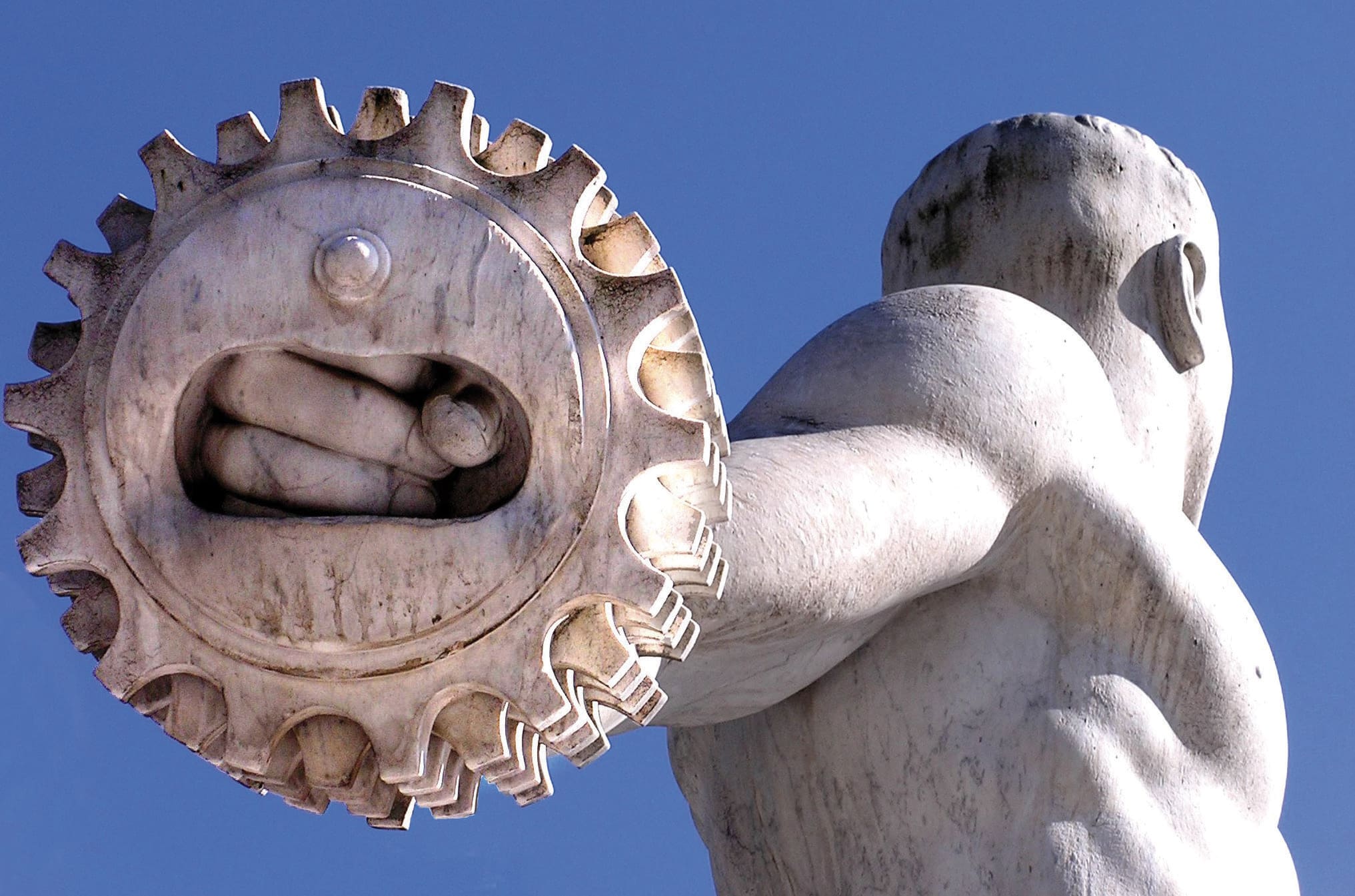
However, the most striking feature of the Foro Italico is the Stadio dei Marmi, or Stadium of Marbles.
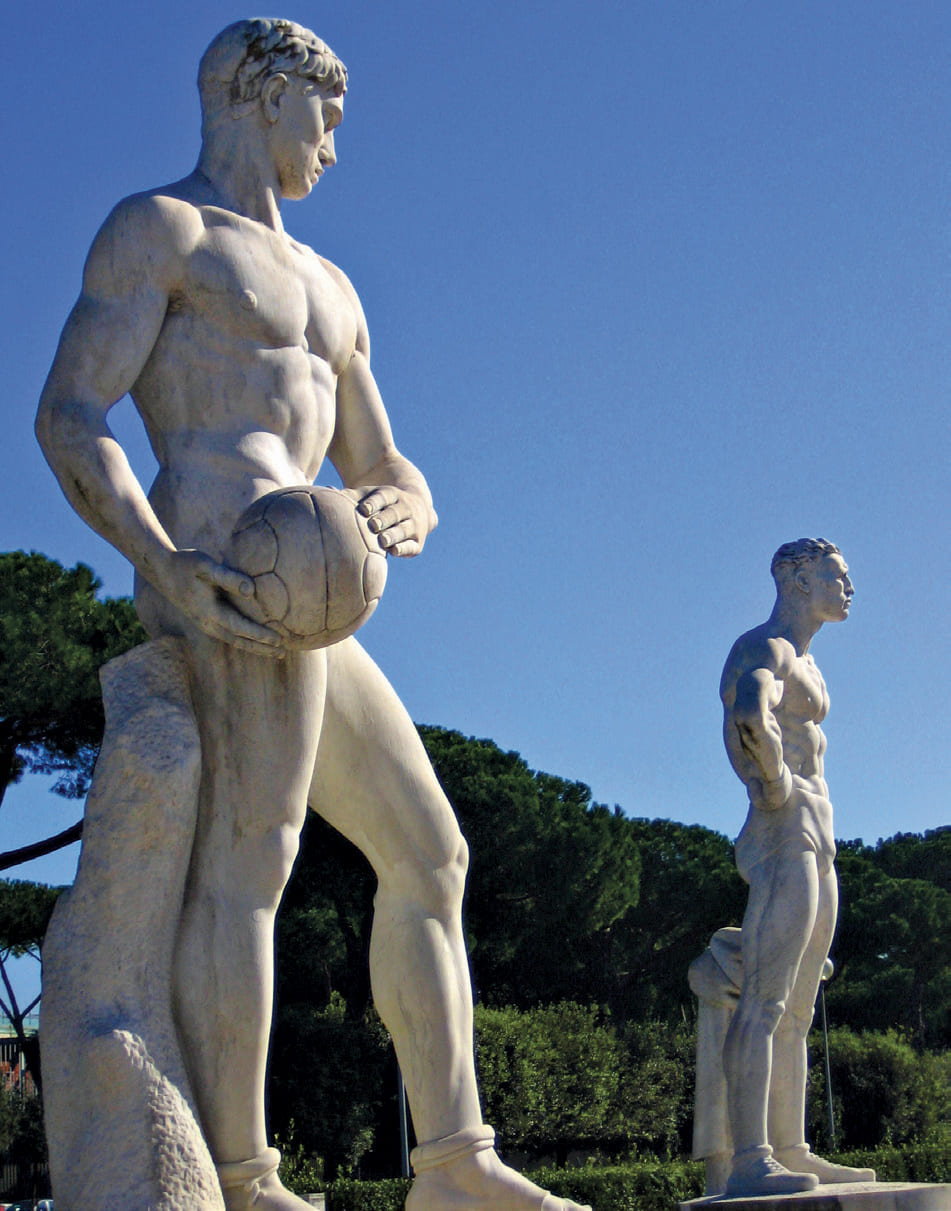
This open-air arena, with its elegant Carrara marble steps, is encircled by 59 larger-than-life statues of nude athletes, each holding a piece of modern sporting equipment such as tennis rackets and cricket bats. At first glance, these statues seem to pay homage to the classical sculptures that adorned Roman sports arenas, but a closer look reveals their distinctly Fascist characteristics—sharp angles, stylized forms, and a sense of physical austerity that reflects the regime’s minimalist aesthetic. Originally designed as a training ground for students of the nearby Academy of Physical Education, the Stadio dei Marmi has since become a symbol of the stark, authoritarian beauty that defined Mussolini’s vision of a new Roman Empire.
Around the stadium, other Fascist-era monuments reinforce this ideological agenda. The marble obelisk, towering and imposing, and the Fountain of the Sphere, with its ancient-style mosaics crafted by Giulio Rosso, further the illusion of a timeless, unbroken connection between ancient Rome and Mussolini’s Italy. Together, these elements create a striking juxtaposition of history, politics, and sport—an architectural and cultural expression of Mussolini’s attempt to mold the present through the lens of Rome’s imperial past.
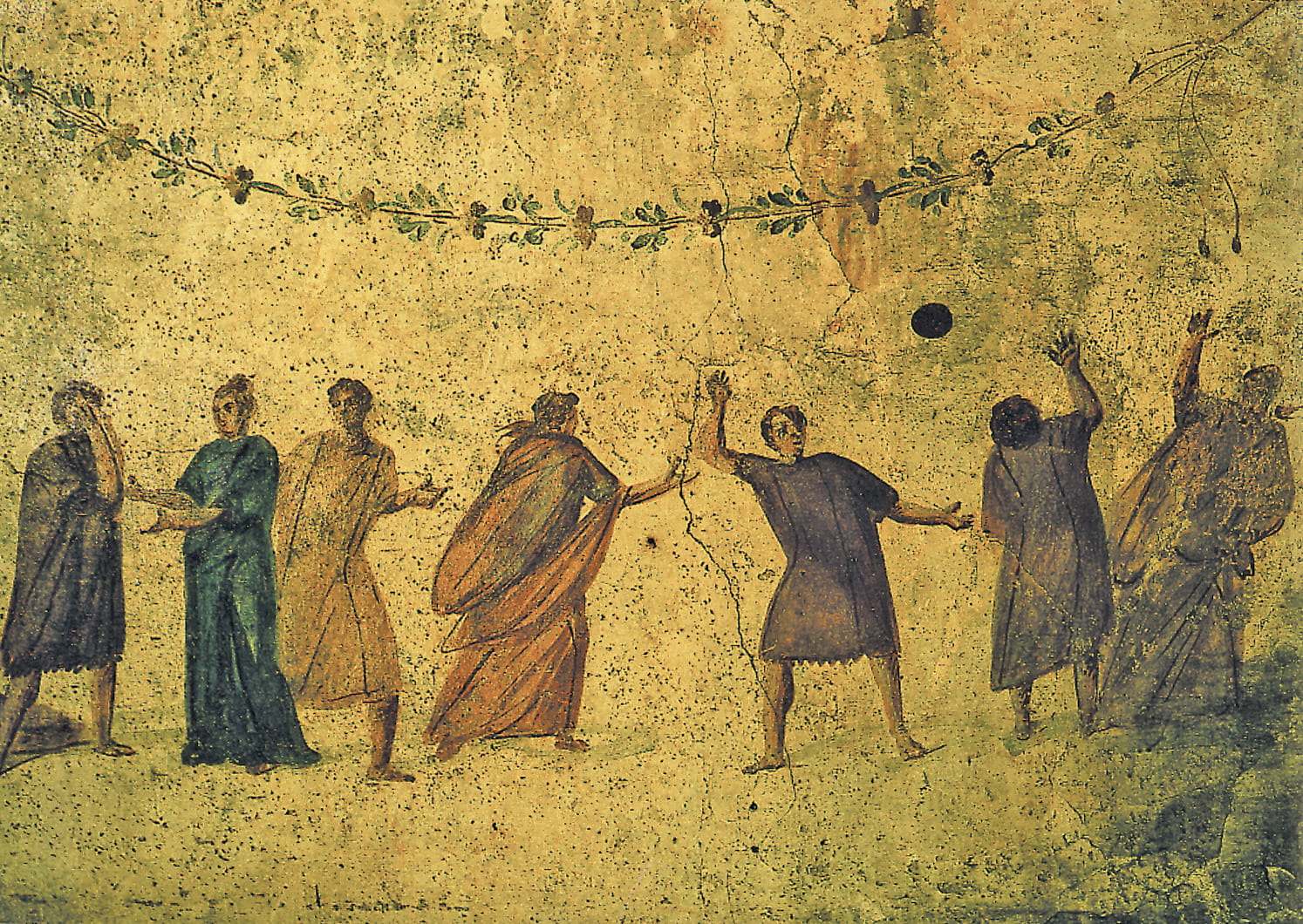
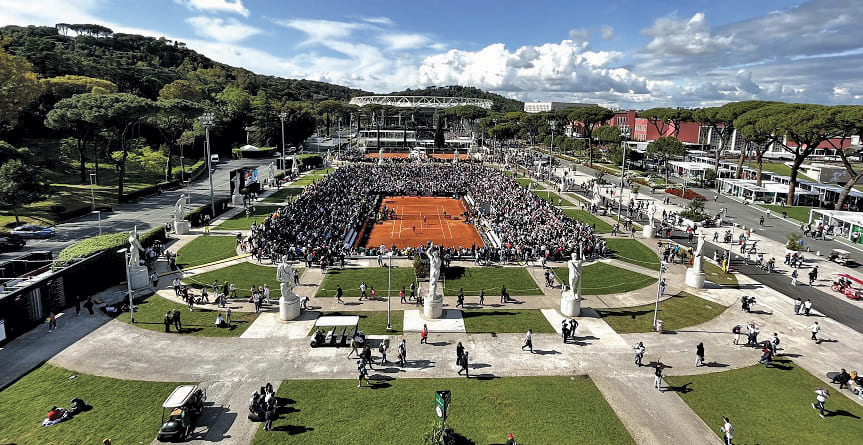
Until 17 May, the sharp pop of tennis balls echoes through Rome’s Foro Italico as the world’s best players compete for the Italian Open title. Yet beneath the modern clay courts lies a far older sporting legacy—one that predates rackets, nets, and baseline battles by centuries. Long before tennis became a global spectacle, the Romans were avid sports enthusiasts with a flair for competition and show. Among their favorite pastimes was expulsim ludere, a primitive form of handball widely believed to be an early ancestor of modern tennis. Played against a single wall—much like today’s one-wall handball—the game required little more than an open space and a solid surface. Courts could be found in bath complexes and private villas, though almost any sturdy wall would do. While no formal rulebook survives, historians speculate that the game used a 21-point scoring system and courts roughly comparable in size to those used today. Players likely wore large, sturdy gloves rather than wielding rackets, though variations of handball and racquet-like games appeared across the ancient world. Archaeological evidence, including inscriptions and drawings, suggests the sport’s popularity stretched far beyond Rome. Some scholars even trace the word “tennis” to Egypt, noting depictions of early racket use and pointing to the ancient port city of Tinnis as a possible linguistic root. As handball gradually evolved into racquet sports-and eventually into modern tennis-today’s players unknowingly follow in the footsteps (and foot faults) of ancient athletes. At the Italian Open, history isn’t just courtside; it’s underfoot. internazionalibnlditalia.com