The sacred passage to the Vatican
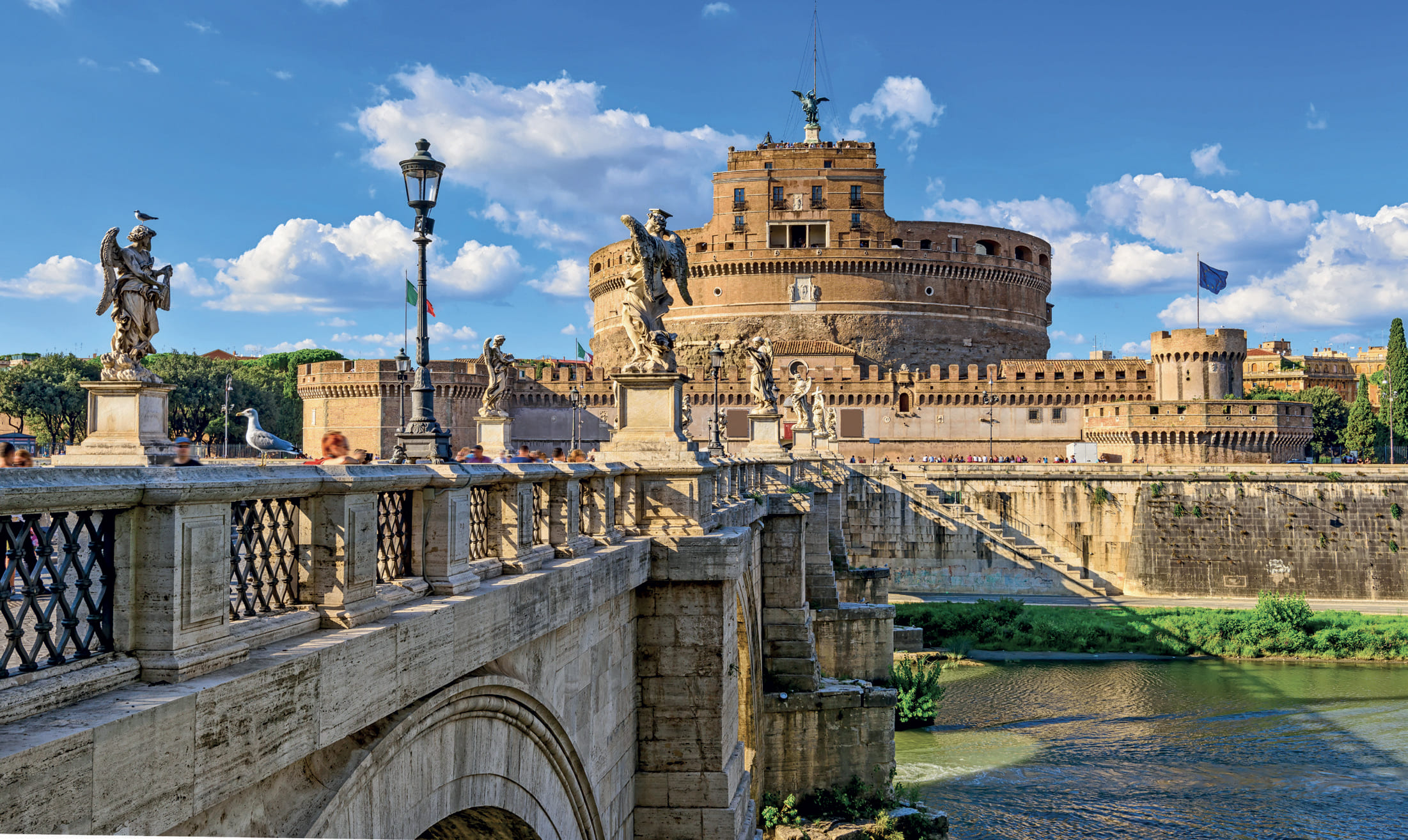
Sant’Angelo bridge is lined with a procession of angelic statues depicting the passion
By Andrea Werther
Often hailed as Rome’s most beauti- ful bridge, Ponte Sant’Angelo is less a thoroughfare than a ceremonial pas- sage: one that draws visitors from the bustle of the city toward the spiritual gravity of the Vatican. Lined with a procession of angels, each frozen in a moment of the passion of Christ, the bridge feels like an open-air ca- thedral, where stone, faith, and history con- verge beneath the Roman sky.
The bridge was built in 136 AD, commissioned by Emperor Hadrian to connect the heart of ancient Rome with his grand mausoleum across the Tiber. Originally called Ponte Elio, the bridge served as a ceremonial approach to imperial power. In 590 AD, during a devastating plague, Pope Gregory the Great reportedly witnessed a vision atop Hadrian’s mausoleum: an an- gel sheathing a sword, signaling the end of divine punishment. The vision transformed the monument into Castel Sant’Angelo, the fortress of the popes—and the bridge took on the name it bears today. From that moment on, Ponte Sant’Angelo became a threshold not just between riverbanks, but between the earthly and the eternal.
Until the late 17th century, the bridge bore only two statues: Saints Peter and Paul, Dreamstime guardians of Rome. Beneath them were etched two stark Latin warnings: “Hinc hu- milibus venia,” meaning “forgiveness for the humble” and “Hinc retributio superbis”, or “punishment for the proud.” These were no empty words. For decades, Ponte Sant’Angelo served as one of Rome’s official execution sites, a public stage for jus- tice and terror.
In 1667, Pope Clement IX entrusted Gian Lo- renzo Bernini with transforming both the bridge and the castle. Bernini imagined the crossing as a spiritual ascent—a sculptural Via Crucis guiding pilgrims toward St. Peter’s. His vision called for ten angels, each bearing an instrument of Christ’s suffering: the crown of thorns, the nails, the cross, the shroud. The effect was meant to overwhelm, to humble, to inspire awe in every soul who passed be- tween Rome and the Vatican.
Bernini sculpted two of the angels himself, The Angel with the Crown of Thorns and the Angel with the Scroll, masterpieces so pow- erful that the pope feared exposure to wind and rain would diminish them. They were re- placed with copies, while the originals were moved indoors to the church of Sant’Andrea delle Fratte, where they remain today—se- rene, intense, and achingly human.