
Mysterious Symbolisms
Decoding the secret language of Roman masterpieces
By Sol Stein
Rome’s greatest artworks are more than masterpieces of beauty. They tell stories of power and ambition, sometimes hiding secret messages and ideas meant to not be understood at first glance: from visual riddles layered with unresolved questions to intriguing symbolism, they often contain stories of secret knowledge, spiritual conflict, and philosophical ambiguity. Here are 8 intriguing artistic mysteries connected to Rome, all acting as secret doors to stories and historical controversies.
Renaissance masters used as models (Raphael’s The School of Athens at Vatican Museums)
In this celebrated fresco, Raphael pays tribute to both the philosophers of antiquity and the great artists of his own time. He populates the ancient world with contemporary faces: Plato is modeled on Leonardo da Vinci, Euclid takes on the features of the architect Donato Bramante, and most famously, Michelangelo appears as the brooding philosopher Heraclitus.
The hidden brain (Michelangelo, The Creation of Adam at Sistine Chapel)
Encircling God are more than a dozen figures, among them the yet-to-be-created Eve, all enveloped within a billowing purple mantle. The outline of this drapery closely resembles a cross-section of the human brain, with the placement of individual figures corresponding to specific anatomical regions. Whether intentional or not, the resemblance has fueled interpretations that link divine creation with human intellect and consciousness.

Caravaggio’s self-portrait (Caravaggio, Head of Goliath at Borghese Gallery)
In David with the Head of defeated Goliath, the severed head is Caravaggio’s own. Painted while he was a fugitive, the work is often interpreted as a silent plea for forgiveness, portraying the artist as both sinner and victim. In the same gallery, Il Bacchino malato (Sick Bacchus) is considered Caravaggio’s first known self-portrait. The pallor of the face and the color of the skin indicate a state of illness.
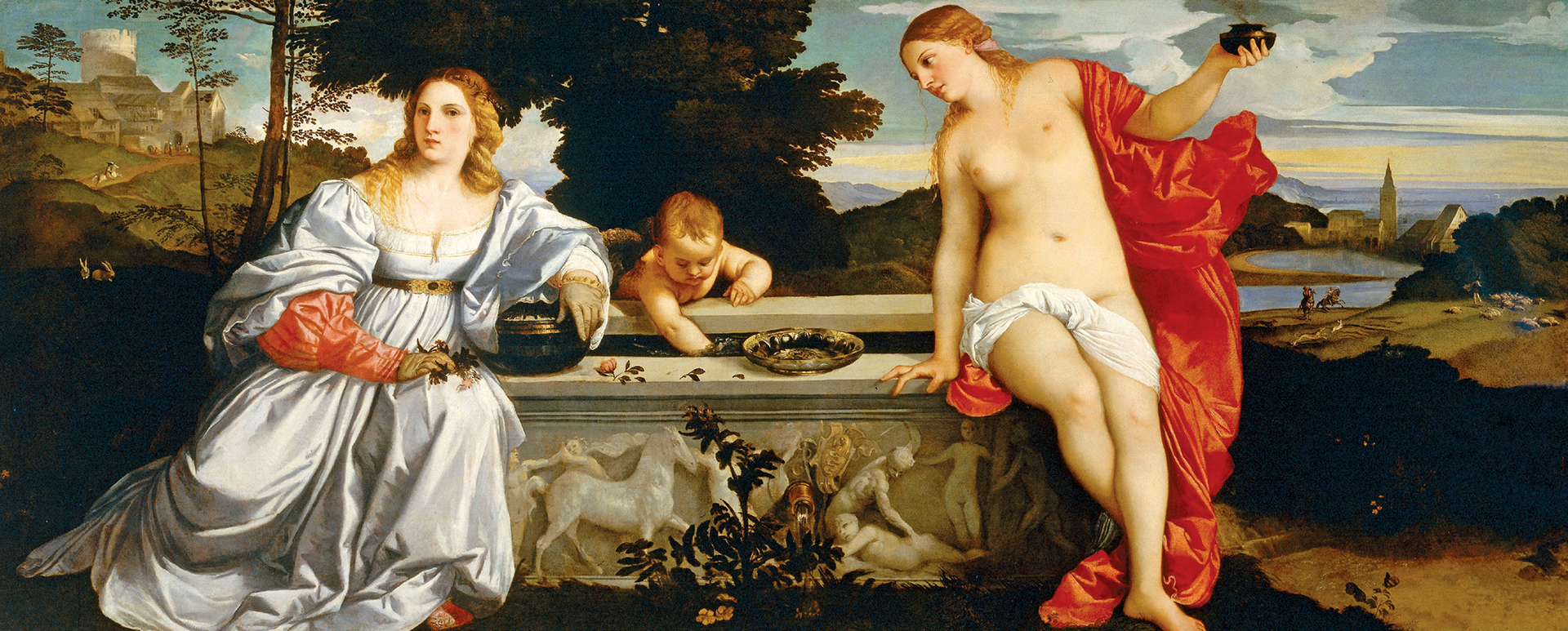
Virtue meets desire (Tiziano, Sacred and Profane Love at Borghese Gallery)
In Sacred and Profane Love, two nearly identical women, one naked, one richly dressed, sit beside an ancient fountain. Despite the title (added later), the painting does not oppose virtue and desire. Instead, inspired by Neoplatonic philosophy, Tiziano suggests that true love has two complementary forms: earthly and spiritual. Cupid, calmly stirring the water, symbolizes their necessary balance.
Sensual devotion (Bernini, Ecstasy of Saint Teresa at Church of Santa Maria della Vittoria)
Bernini’s Ecstasy of Saint Teresa blurs the line between mystical transcendence and sensual experience. The saint’s expression is intensely emotional, unsettling viewers and challenging strict divisions between sacred devotion and human desire.

Save the date for the end of the world (Leonardo Da Vinci, Last Supper tapestry, Vatican Museums)
Leonardo’s Last Supper tapestry in the Vatican (an exact copy of the famous fresco in Milan) is said to hide a coded calendar based on astronomy and zodiac symbolism. The imagery allegedly predicts the end of the current world through a universal flood beginning on 21 March 4006 and ending on 1 November, when Christ returns to inaugurate a new era, marking the transition from Pisces to Aquarius.
Petrified Perseus (Antonio Canova, Perseus Triumphant with the Head of Medusa, Vatican Museums)
An illustrious example of sculptor Antonio Canova’s art that deserves special attention is Perseus Triumphant with the Head of Medusa on display in the Vatican Museums. The eyes of the gorgon can petrify anyone who looks into them, which is what seems to have happened to Perseus here. Legend states that the work is so perfect that it is nothing less than the Greek hero’s body turned into marble.
Hidden symbols (Raphael’s Deposition at Borghese Gallery)
Raphael’s Deposition is rich in symbolic balance and emotion. The diagonal movement of Christ’s body suggests the passage from death to salvation, while the bearers echo a pietà, linking human grief to divine purpose. Mary’s faint mirrors Christ’s fall, symbolizing shared suffering, and the rocky landscape contrasts death with the promise of resurrection and redemption.