

Rome by the Numbers
Discover Rome through the numbers that tell its story
By Claudio Lozzi
Seven hills, two legendary founders, thousands of fountains, centuries of history. Rome can be counted in countless ways. Here are some numbers that reveal the Eternal City from a different perspective.
0 Skyscrapers in the historic centre
Rome’s historic centre has no skyscrapers. Its skyline is instead defined by domes, bell towers, obelisks and ancient monuments.
1 The Colosseum
There is only one Colosseum. Nearly two millennia after its creation, this ancient arena remains Rome’s unmistakable icon and one of the world’s most extraordinary architectural treasures. As one of the New Seven Wonders of the Modern World, the Colosseum proudly reigns as the most famous and visited monument in Italy.
2 Rome’s twins, Romulus and Remus
Two brothers, one she-wolf and a legendary rivalry. According to tradition, Romulus and Remus were the twin founders of Rome, with Romulus eventually becoming the city’s first king.
3 The three fountains
At the Abbey of the Three Fountains, legend has it that when St Paul was beheaded, his head bounced three times. At each spot, a spring miraculously appeared — giving the site its name.

4 The four rivers
At the centre of Piazza Navona, Bernini’s spectacular Fountain of the Four Rivers represents four great rivers of the world: the Nile, Ganges, Danube and Río de la Plata.
5 The five scole
Piazza delle Cinque Scole, in the heart of Rome’s Jewish Ghetto, takes its name from the five synagogues, or scole, that once served the city’s Jewish community.
6 The Vestal Virgins
Six priestesses once guarded the sacred flame of Vesta, keeping it burning day and night. Their unusual position gave them remarkable privileges in a society where women otherwise had limited public power.
7 Rome’s magic number
Seven hills. Seven legendary kings. Seven cohorts (coorti) of ancient Roman firemen (vigiles). Seven traditional pilgrimage churches. Few numbers are more deeply woven into Rome’s identity.
9 Ancient arches
Rome has far more monumental arches than the famous three of Constantine, Titus and Septimius Severus. Look around and you will find the Arch of Gallienus, Arch of Dolabella, Arch of Drusus, Arch of Janus and Arch of the Argentarii, among others.
11 Aqueducts
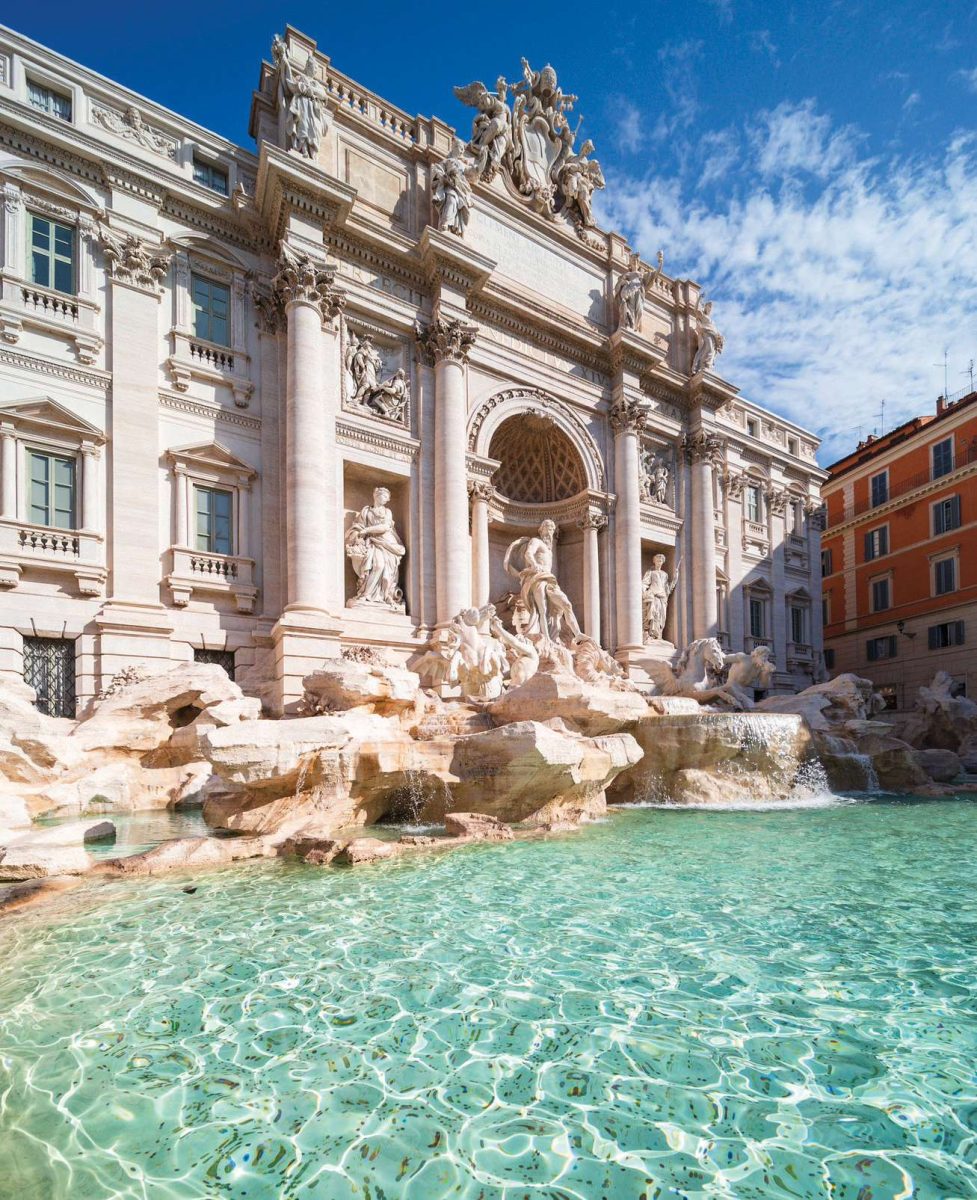
Eleven major aqueducts supplied ancient Rome with an extraordinary abundance of fresh water. The oldest, the Aqua Appia, dates to 312 BC; the Aqua Marcia stretched for about 91 kilometres. Some of Rome’s ancient water systems still serve the city today: the Aqua Virgo, for example, supplies several famous fountains, including the Trevi Fountain.
13 Obelisks
Rome is home to 13 ancient obelisks, more than any other city in the world. Most were brought from Egypt during the Roman era, while others were carved in Rome in imitation of Egyptian originals. Today they rise dramatically above piazzas, fountains and churches across the city.
40 Bridges over the Tiber
Around 40 bridges cross the Tiber within Rome’s urban area, linking the two sides of the city and connecting some of its most historic neighborhoods.
43,3 meters: the Pantheon dome’s diameter
Because the height and diameter are identical, the interior space of the Pantheon forms a mathematically perfect, invisible 43.3-meter sphere. A massive globe could fit perfectly inside the building, touching the floor, walls, and ceiling simultaneously.
108.7 acres. The size of Vatican City
The world’s smallest independent state covers just 108.7 acres — roughly 44 hectares — yet contains an astonishing concentration of art, architecture and history.

135 Spanish Steps
The famous Spanish Steps have 135 steps, connecting Piazza di Spagna with the church of Trinità dei Monti above. Their sweeping Baroque design has made them one of Rome’s most recognizable meeting places.
284 St Peter’s columns
The monumental colonnade embracing St Peter’s Square consists of 284 columns, arranged in four rows, creating Bernini’s celebrated “arms” around the piazza.
800 m²: Area of the Sistine Chapel ceiling
Michelangelo’s celebrated ceiling frescoes cover roughly 800 square meters, transforming the chapel into one of the greatest masterpieces of Western art.
900 Churches
Rome is traditionally said to have around 900 churches, from monumental basilicas to tiny neighborhood chapels. Some remain active places of worship while others have been deconsecrated or given new uses.
2,000 Fountains
Rome has an estimated 2,000 fountains, from monumental masterpieces such as the Trevi Fountain and Fontana dei Quattro Fiumi to tiny nasoni — the city’s ubiquitous drinking fountains.

2,779 Years since Rome’s foundation
Rome’s traditional foundation date is 753 BC, meaning the city has been continuously shaped by over 2,500 years of history, legend, and reinvention.
50,000 Colosseum spectators
The Colosseum could accommodate an estimated 50,000 spectators, who entered through a remarkably sophisticated system of numbered entrances and corridors.
150,000 Circus Maximus spectators
At its height, the Circus Maximus may have held up to 150,000 spectators, making it one of the largest entertainment venues ever built. Chariot racing was its great attraction.
1,000,000+ Euros worth of coins
More than a million euros’ worth of coins are tossed into the Trevi Fountain each year. The money is collected and used for charitable purposes.
1–2 million Population of Imperial Rome
At the height of the Roman Empire, Rome may have been home to between one and two million people, making it one of the largest cities in the ancient world.
2,740,000 Rome population, 2026
2.74 million is the number of Rome’s inhabitants estimated in 2026 within city limits; 4.22 million people in the broader metropolitan area (Official source: World Population Review).